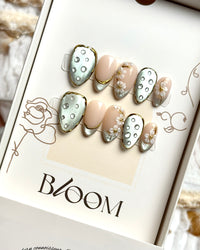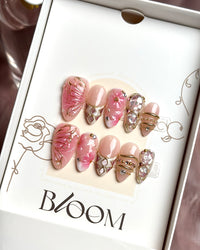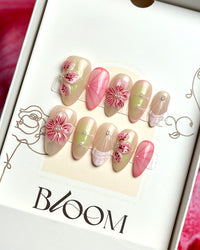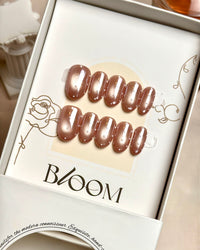
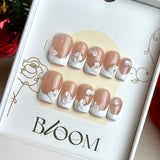
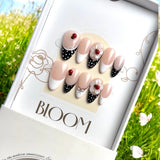
 Sweet Alibi
 A Polite Distraction
 Amber After Hours
How to Reuse Press-On Nails (and Store Them Between Wears)
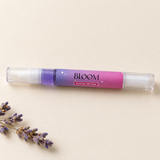
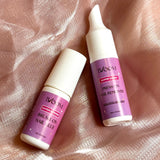
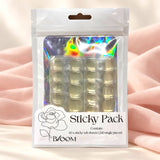
Yes, Bloom press-on nails can be reused. Learn how to remove them gently, clean each nail, store your set and reapply with fresh glue or sticky tabs.


The short answer: press-ons themselves aren’t the problem. How they go on, and especially how they come off, is what decides whether your natural nails stay healthy.
| Press-ons | Gel manicure | Acrylic | |
|---|---|---|---|
| Application | Glue or sticky tabs, at home | Polish cured under a UV/LED lamp | Liquid and powder sculpted onto the nail |
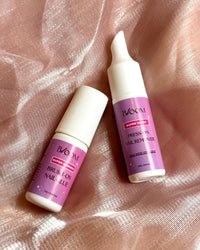
| Removal | Remover oil: 1–2 minor a long, warm, soapy soak | Usually an acetone soak or filing | Usually an acetone soak or filing |
| Drill or e-file | None | Sometimes used | Often used |
| Reusable | Yes | No | No |
| Main risk | Prying off before the adhesive softens | Thinning and peeling from removal | Thinning from filing and removal |
The advantage of press-ons is that you control every step, and removal never needs acetone or a drill.

You can wear press-ons back to back as long as your nails feel healthy. Leave them bare, with cuticle oil every day, if you notice:
Once they feel strong again, you’re ready for your next set. If you have pain, redness, swelling, a rash, or a nail lifting away from the nail bed, see a doctor or dermatologist.
Ready for your next set? Follow our guide on how to make press-on nails last up to 3 weeks, and learn how to reuse your press-ons.
Not when they’re applied and removed correctly. Press-ons sit on top of your natural nail with no UV lamp and no drilling. Most damage comes from prying them off, over-buffing, or covering nails that are already damaged.
Yes. Press-ons skip the UV lamp, the drill and the acetone soak that gel and acrylic usually need, and they come off with remover oil in 1–2 minutes or a long, warm, soapy soak. Just prep and remove them gently, like any nail product.
Peeling usually means a press-on was pulled off while the adhesive was still hard, or the nails were buffed too hard. Always soften the adhesive first, buff with a light touch, and use cuticle oil after removal. If peeling continues, leave your nails bare and see a dermatologist.
Yes, as long as your natural nails feel healthy. Remove each set gently and check your nails before reapplying. If they feel thin or sore, or start to peel, leave them bare for a while with cuticle oil before your next set.
Remove the set gently with remover oil or a long, warm, soapy soak; don’t force it. Discomfort can come from a size that presses on the skin or glue touching the skin. If pain, redness, swelling or a rash continues, see a doctor or dermatologist.
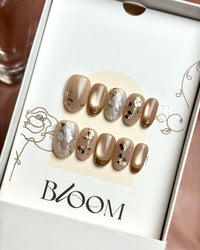
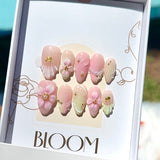
Our newest bestsellers, hand-painted in salon-grade gel and made to be worn again and again.
Want to try a set on in person? Visit Bloom Nails at Westfield Valley Fair in San Jose or Westfield Century City in Los Angeles. See our store locations and hours.